




Verifi specialises in dispute management, aiding sellers in revenue retention and cost reduction from banks.
Contents
Recommended Articles
Mastercard’s GMAP: What merchants should know about the new risk framework
What is Payment Orchestration? A Complete Guide for Businesses in 2026
Payment orchestration is a software layer that connects your business to multiple payment service providers, acquirers, banks and other financial services through a single platform, it allows you to manage transactions across various partners and optimises success...
What is BIN in Card Payments? A Guide Every Merchant Need
Most businesses today close sales through conversations, not just via websites or apps. Customers interact with your brand across various channels, including Instagram, WhatsApp, email, and live chat.
Share This Post
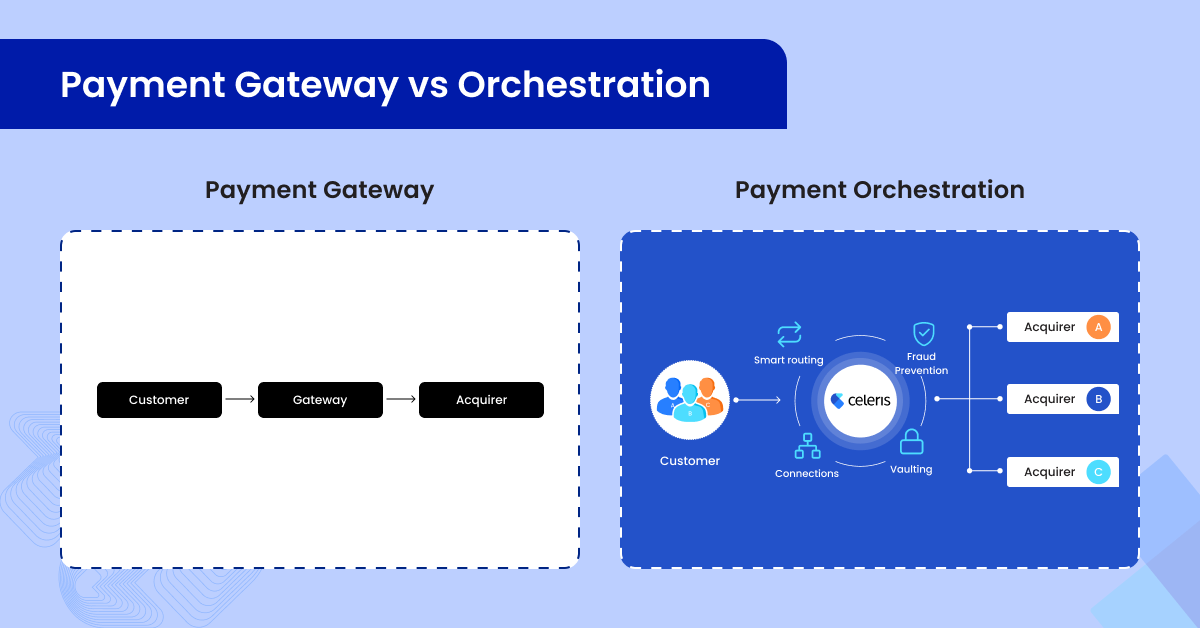
A payment gateway processes transactions through one acquirer. A payment orchestration platform routes each transaction to the most suitable acquirer within its connected network and automatically retries it with a second acquirer if the first fails.
Most existing articles either blur the two together or write for people who’ve never touched a payment integration.
This article assumes you already know what a gateway does. The more important question is: where does a payment gateway-only setup start to limit your capabilities, and what can orchestration do that a gateway can’t?
The Architectural Relationship Between a Payment Gateway and an Orchestration Platform
A payment gateway is a component. An orchestration platform is a layer that sits above and manages multiple components, including gateways. The two do not compete; they occupy different positions in the payment stack.
Every payment stack has three layers, regardless of how simple or complex the infrastructure is:
-
Checkout and data capture:The form or the checkout page where the customer enters payment details. Card data is collected here, tokenised, and passed downstream. This layer determines PCI scope.
-
Routing and intelligence:The layer that decides which acquirer or PSP receives the transaction. In a single-gateway setup, this layer exists but is fixed and controlled by the gateway or PSP, with no merchant-level routing control. In an orchestrated setup, this is where routing rules, BIN analysis, PSP health checks, cascading logic, and analytics live.
-
Acquiring and settlement:The PSPs and acquiring banks that process the authorisation and move funds from the issuing bank to the merchant account. Every PSP includes a gateway component at this layer, along with acquiring and processing capabilities.
A payment gateway sits between layers 1 and 3, capturing payment data at checkout and transmitting it to an acquirer.
An orchestration platform occupies layer 2. It receives the tokenised data, decides which of the connected acquirers at layer 3 should process it, and manages the outcome, including failover.
Without layer 2, there’s no routing decision being made, every transaction goes to one acquirer by default, and that acquirer’s approval logic becomes the ceiling on your performance, whether or not it’s the best fit for a given card. The result is that transactions are consistently routed to the same acquirer, which works until the limitations of that acquirer become the ceiling on the merchant’s approval rate.
What a Payment Gateway Does and Where Its Limits Begin
A payment gateway captures card credentials from checkout, encrypts them, and submits an authorisation request to its acquiring bank or PSP. Then the acquirer forwards the request through the card network to the issuing bank, which approves or declines. The response typically comes back in a couple of seconds.
-
Secure data capture : accepting card details via a hosted payment page, embedded iFrame fields, or a server-to-server API integration.
-
Tokenisation : replacing the raw card number with a token so cardholder data stays out of the merchant’s servers.
-
Authorisation submission : sending the transaction to one acquirer and receiving the approval or decline response.
-
Settlement : batching authorised transactions and forwarding them to the acquirer for clearing and settlement to the merchant’s account.
Those 4 functions are the complete scope of what a gateway does. It moves encrypted transaction data between your checkout and one acquirer, reliably and at scale. The structural limitation is built into that last phrase, (one acquirer). When that acquirer declines a transaction, the gateway returns a decline.
There is no routing logic to evaluate whether a different acquirer with a stronger relationship on that card’s BIN range would have approved it. There is no automatic failover when the acquirer experiences downtime. The gateway has no mechanism for any of this.
What Payment Orchestration Platform Adds
A payment orchestration platform is layer 2 in the payment stack. It receives tokenised transaction data from checkout. It then evaluates available acquirers in real time based on factors like BIN data, card type, issuer country, transaction value, and live approval performance, selects the optimal routing path, submits the authorisation, and handles the outcome.
Many acquirers pass VAMP-related penalties down to merchants through processing fees, compliance assessments, or account terminations. Smart merchants recognise that helping their acquirer stay VAMP-compliant protects their processing relationships and keeps costs manageable.
When the first acquirer returns a soft decline, the platform automatically retries the transaction through the next acquirer in the cascade based on predefined routing logic.
When an acquirer’s performance degrades, traffic is automatically shifted to healthier alternatives in near real time without manual intervention.
Here are the 6 capabilities orchestration adds beyond traditional gateway architecture:
-
Dynamic per-transaction routing : Each transaction is routed to the acquirer with the highest approval probability for that card’s BIN, issuer country, type, and the acquirer’s real-time performance on that card type.
-
Automatic cascading failover : Soft declines can be retried through a secondary PSP within seconds, typically without requiring additional customer input.
-
Single API for multiple PSPs : One integration gives you access to 100s of payment methods and acquirers, and new PSPs connect without new engineering integrations.
-
Secure token vault : Card tokens are stored centrally and remain portable across connected PSPs, so stored credentials belong to the merchant rather than a single provider, not to whichever PSP created the token.
-
Unified cross-PSP analytics : Approval rate, processing cost, decline reason codes, and PSP health are visible in one real-time dashboard across the payment stack.
-
Automated reconciliation : Settlement data from all connected PSPs is aggregated automatically, with matched transaction records across all acquirer relationships.
Payment Gateway Vs Payment Orchestration: 12 Direct Differences
| Capability | Payment Gateway | Payment Orchestration |
|---|---|---|
| Core function | Transmits transactions to one acquirer | Routes each transaction to the most optimal acquirer in real time |
| Acquirer access | Limited to one acquiring relationship | Access to 50+ PSPs through a single API integration |
| Routing logic | No routing logic, transactions are sent to a fixed acquirer | Supports rule-based, BIN-based, cost-based, and data-driven routing in real time |
| Soft decline handling | Returns the decline with no automated retry mechanism | Cascades to the next PSP automatically, no engineering effort required |
| Token portability | Tokens are locked to a specific PSP and cannot be reused | A centralised token vault allows tokens to be used across all connected PSPs |
| Performance visibility | Limited to individual gateway-level reporting | Unified view of approval rates, costs, and decline reasons across all PSPs |
| Reconciliation | Requires manual consolidation of multiple PSP statements | Automated reconciliation across multiple PSPs in a single system |
| New PSP onboarding | Requires full engineering effort for each new integration | New PSPs can be added quickly without additional API integration effort |
| 3DS management | Single 3DS configuration tied to one acquirer | Dynamic 3DS routing across acquirers with optimised frictionless flows |
| PCI scope | PCI scope depends on the integration model and gateway architecture | Reduced PCI scope through centralised tokenisation and hosted checkout |
| Acquirer redundancy | No failover path, one acquirer going down takes checkout down with it. | Built-in redundancy with automatic traffic redistribution during failures |
| Processing cost visibility | Limited visibility with blended pricing | Granular cost visibility by PSP, card type, and transaction level |
Does Adding Orchestration Mean Replacing Your Gateway?
No, and this is one of the most common misconceptions in the evaluation process. Orchestration does not remove existing gateway or PSP relationships from the stack. Each PSP in an orchestration network is, at its core, a gateway. The orchestration platform routes between them, not around them. Existing PSP and acquiring contracts remain in place when orchestration is added. The current acquirers become nodes in the routing network rather than the only option.
For markets where a merchant has no existing acquirer coverage, an orchestration platform can provide access to PSPs in the network that the merchant has not previously had a direct relationship with.
The integration model works in both directions: merchants who have already built multiple PSP integrations can connect their existing PSPs to the orchestration layer and immediately gain routing intelligence, cascading, and unified analytics above those relationships, without a commercial renegotiation or a new PSP agreement.
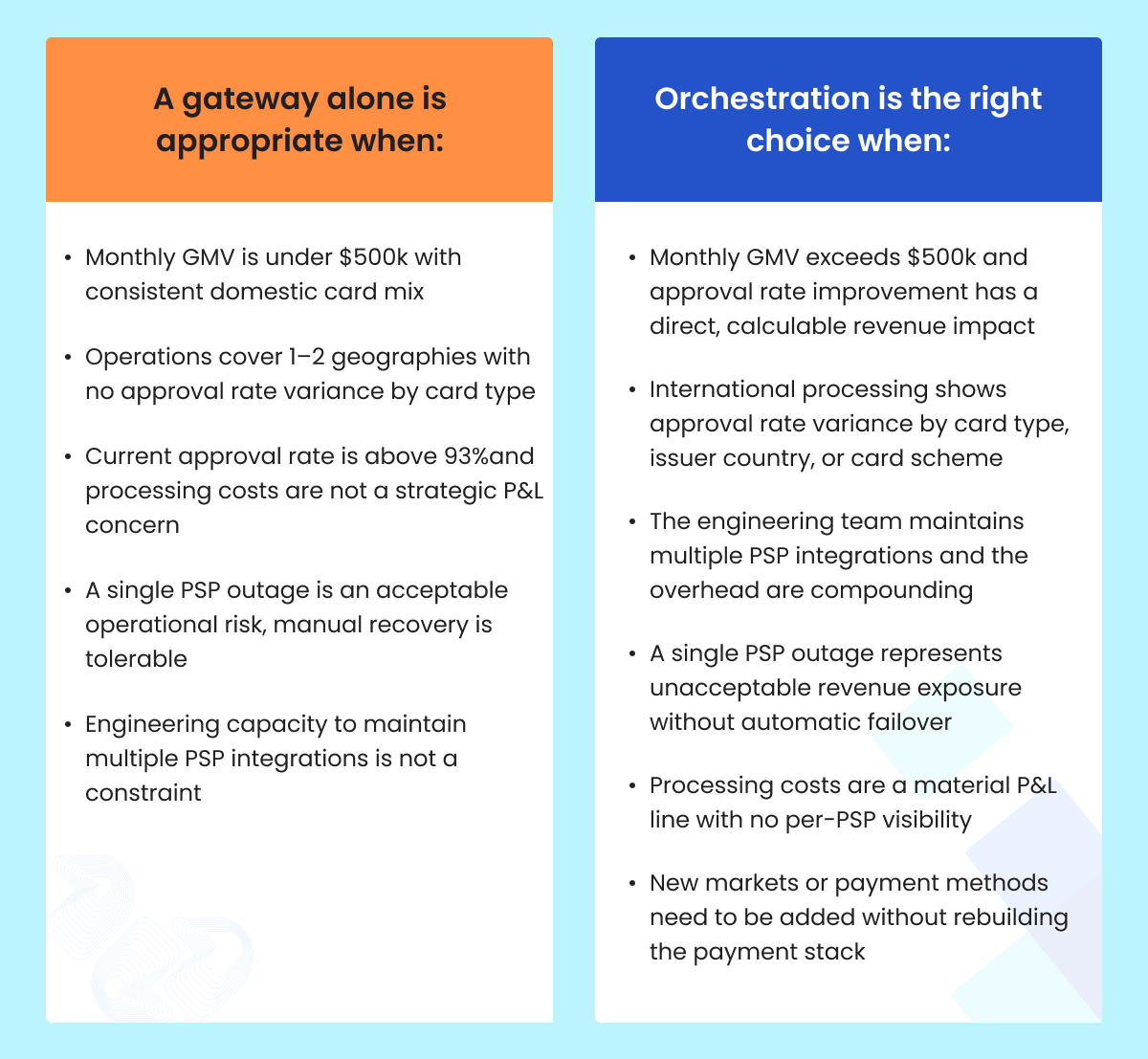
Gateway vs Orchestration: What’s Right for Your Business and When?
Whether orchestration makes sense depends on where you are operationally. The signals below help distinguish when a gateway is enough and when it is not.
Stop Guessing. Start Orchestrating.
If you’re running multiple PSPs, expanding into new markets, or losing transactions to declines you can’t explain, that’s exactly what Celeris is built to fix.
-
One platform to manage every PSP, acquirer, and payment method you work with, instead of juggling separate platforms and contracts.
-
Access to 100+ payment methods and 75+ acquirers through a single integration.
-
Routing that picks the best acquirer per transaction, not a fixed default.
-
Automatic recovery when a transaction fails the first time.
-
Built-in fraud and chargeback tools and security standards that meet the highest industry benchmarks
Get in touch with Celeris to see how it fits your current stack.

Asked
What is the difference between a payment gateway and a payment orchestration platform?
A payment gateway moves transactions from your checkout to one acquirer. That is its entire job. A payment orchestration platform connects to multiple acquirers and decides, for each transaction, which one should process it based on the card type, issuer country, and real-time acquirer performance. One executes. The other decides and then executes.
Does a payment orchestration platform replace my existing payment gateway?
What is cascading in payment orchestration, and how does it work?
Let's Connect
Just a few quick details. Our team will reach out to explore how our platform fits your payment stack and objectives.
Talk with one of our payment experts
Ready to elevate your business to new heights? Schedule a call with our experts to discuss your unique needs and uncover tailored solutions. Don’t let questions linger – seize the opportunity to pave your path to success!
Winner !
Best use of data analytics, MPE 2025
Best Payments Orchestration Solution, MPE 2024